

“RENCONTRES MUSICALES”:
The venues
The Rencontres Musicales festival takes place in Conegliano: the city, with its most precious and evocative spaces, will become an enchanting stage.
The musical compositions of the most famous composers will resonate within the Convent of San Francesco, along the Madonna della Neve promenade and the city walls, filling the halls of the Sala dei Battuti, the Teatro Accademia, and its foyer. The center of this event will be Villa Gera, a symbol of patronage and culture, a prestigious setting that is the quintessence of a landscape we love.
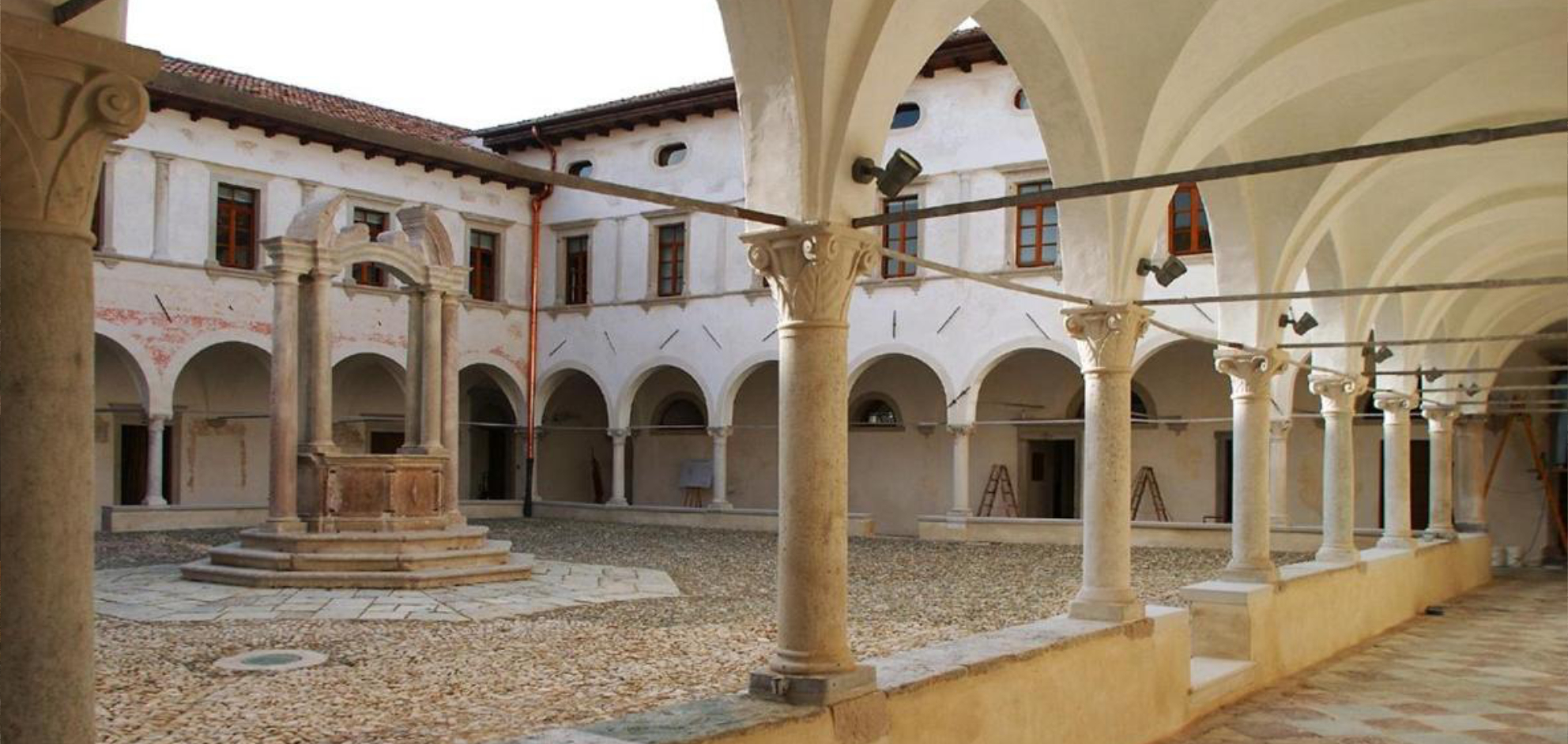
Campus San Francesco
A former convent transformed into a place of encounter and growth—a space where new synergies can be forged. A charming venue that, over the centuries, has provided the backdrop for unforgettable experiences.
The Campus today:
Campus San Francesco is housed within the former convent of San Francesco, one of Conegliano’s most important and iconic monuments, renowned for its historical and artistic significance. Thanks to careful restoration and refurbishment, the Campus is now an accommodation facility offering sustainable hospitality for students, professionals, and tourists. This is made possible through its management by CSA – Centro Servizi Associati, a social cooperative specialising in the design and operation of high-quality accommodation services for both national and international guests. The tradition and mission of Campus San Francesco make it an ideal setting for hosting students, trainees, and professionals engaged in education, training, and professional development programmes. Today, the Campus is also open to private individuals, organisations, and companies wishing to discover and experience this remarkable historic setting.
A Brief History:
The former convent, built between 1371 and 1411 by the Franciscan Order, reached its full extent in the 18th century with the construction of two cloisters, a large single-nave church featuring nine altarpieces and an apse housing the Madonna della Neve, as well as a spacious orchard and a well-stocked library. During the Napoleonic era, the convent fell into decline: its rooms were converted into military quarters, armouries, infirmaries, shelters for the poor and elderly, and later into a school, a function it retained until 2000.
In 2000, the Cassamarca Foundation of Treviso undertook major restoration works, bringing to light the complex as it appears today, now home to Campus San Francesco. Of the original convent, only the main cloister remains, preserving its Renaissance charm. In the centre of the spacious courtyard stands a 17th-century well, surrounded by elegant round arches supported by columns with Composite capitals.
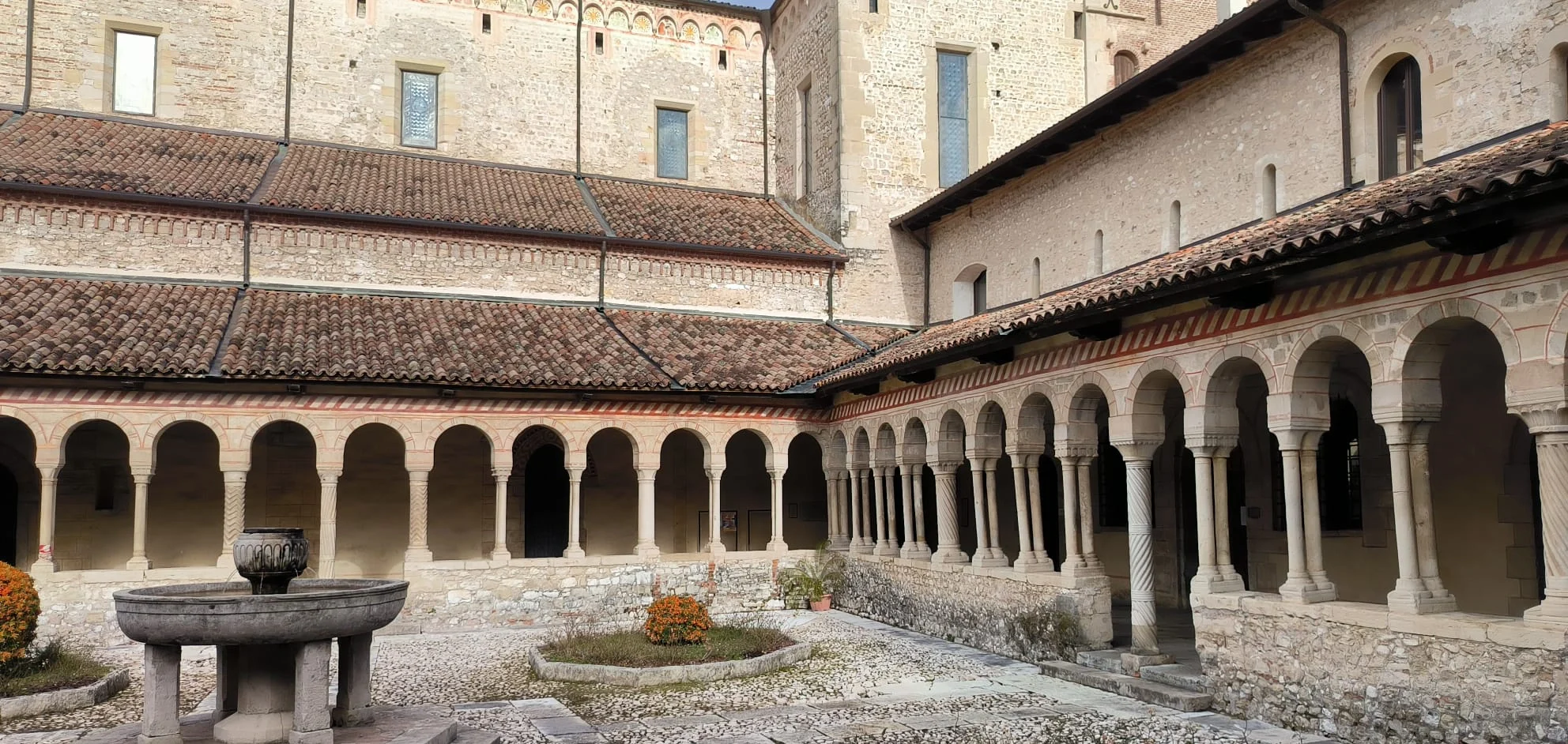
Abbey of Santa Maria di Follina
The Parish:
The Abbey of Santa Maria di Follina, in the province of Treviso, originated as a Cistercian monastery. In 1819, the parish developed around this important place of worship, making it a focal point for both the local community and visitors. Its location, a short distance from the Praderadego and San Boldo passes, has made it an important stop for pilgrims over the centuries. The abbey church was elevated to the rank of minor basilica in 1921. At that time, the parish priest was Father Anacleto Maria Milani, Servant of Mary—a guiding figure for the Follina community and a strong advocate for the restoration of the building. It is to him that we owe not only the recognition of the basilica but also its designation as a National Monument and the solemn coronation of the statue of the Madonna by the Patriarch of Venice.
The sanctuary:
A jewel of Romanesque-Gothic architecture, the sanctuary of Santa Maria di Follina stands at the foot of the Treviso Pre-Alps, between Vittorio Veneto and Valdobbiadene. Its location, a short distance from the Praderadego and San Boldo passes, has made it an important stop for pilgrims over the centuries. The abbey, which has safeguarded since time immemorial the image of the Madonna and Child—an ancient stone statue of unknown origin—is itself a destination of deep devotion. A focal point within the Diocese of Vittorio Veneto, it has long maintained a special bond with the faithful of the Piave basin and the Belluno valleys. This spiritual connection is still renewed each year through the centuries-old Pentecost pilgrimage of the people of Alpago. Today, the sanctuary also attracts an increasing number of visitors from across Italy and Europe, drawn by the beauty and tranquillity of the cloister and the depth of its history.
The Basilica:
The church of the Abbey of Follina was elevated to the rank of minor basilica in 1921. This important milestone occurred during a period of great upheaval, coinciding with the restoration of the abbey complex, which had fallen into disrepair after the cloister had been converted into dwellings and had also been damaged by a bomb towards the end of the First World War. At that time, the parish priest was Father Anacleto Maria Milani, Servant of Mary—a guiding figure for the Follina community and a passionate advocate for the restoration of the complex. It is to him that we owe not only the recognition of the basilica, but also its designation as a National Monument and the solemn coronation of the statue of the Madonna by the Patriarch of Venice.
History:
The Abbey of Santa Maria di Follina is a monastic complex situated at the foot of the Treviso Pre-Alps. Its original layout is the work of the Cistercian monks, who arrived in the valley – the ancient Valmareno – around the mid-12th century. Construction of the new building began on a site that had previously been occupied by a settlement, about which no information is available today, but which is attested by the discovery, in the post-war period, of architectural remains beneath the church floor.
The Cistercian complex – which, as St Bernard stipulated, was to be situated near water, a mountain and open land, and ensure silence – features the place of worship alongside the areas of daily life, linked by the construction of the cloister in 1268. The latter, the true beating heart of the abbey, is distinguished by its forest of leaf-decorated capitals, representing in an elegant petrified forest the…
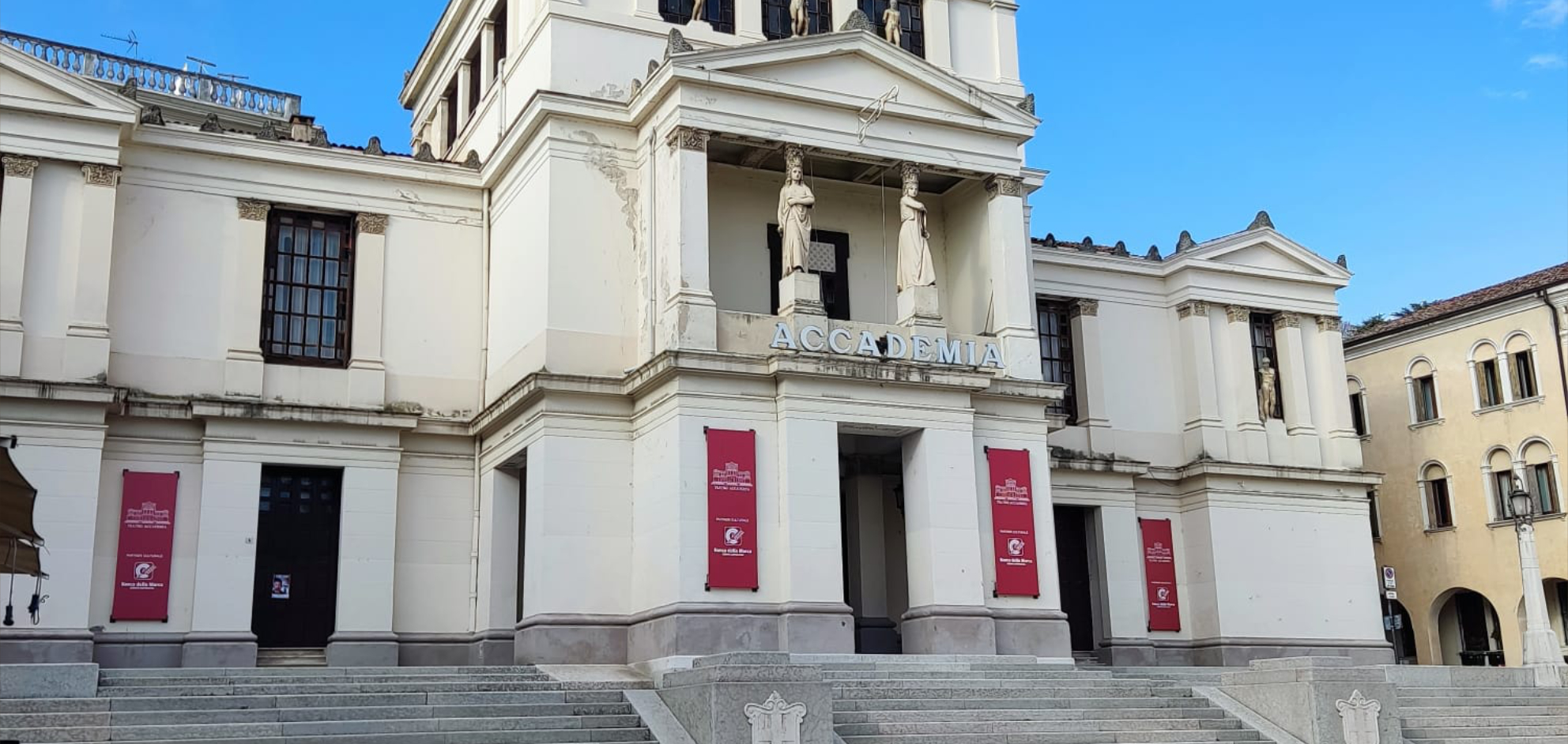
Teatro Accademia
In the heart of Conegliano stands the Teatro Accademia, a building in typical neoclassical style, whose grand façade dominates Piazza Cima, rising above a flight of steps flanked by two distinctive stone sphinxes. The entrance is accessed through a portico, whose central section projects towards the square.
Construction began under Austrian rule and was completed in 1868. Built to replace the old Teatro Concordia in Contrada Borghetto (now Via Teatro Vecchio), which could no longer meet demand, the theatre was designed by the Udine-based architect Andrea Scala. It was inaugurated on 5 September 1869, with a performance of Gioachino Rossini’s Il Conte Ory.
Renovated several times since 1937, the theatre has also been used as a cinema since 1946.
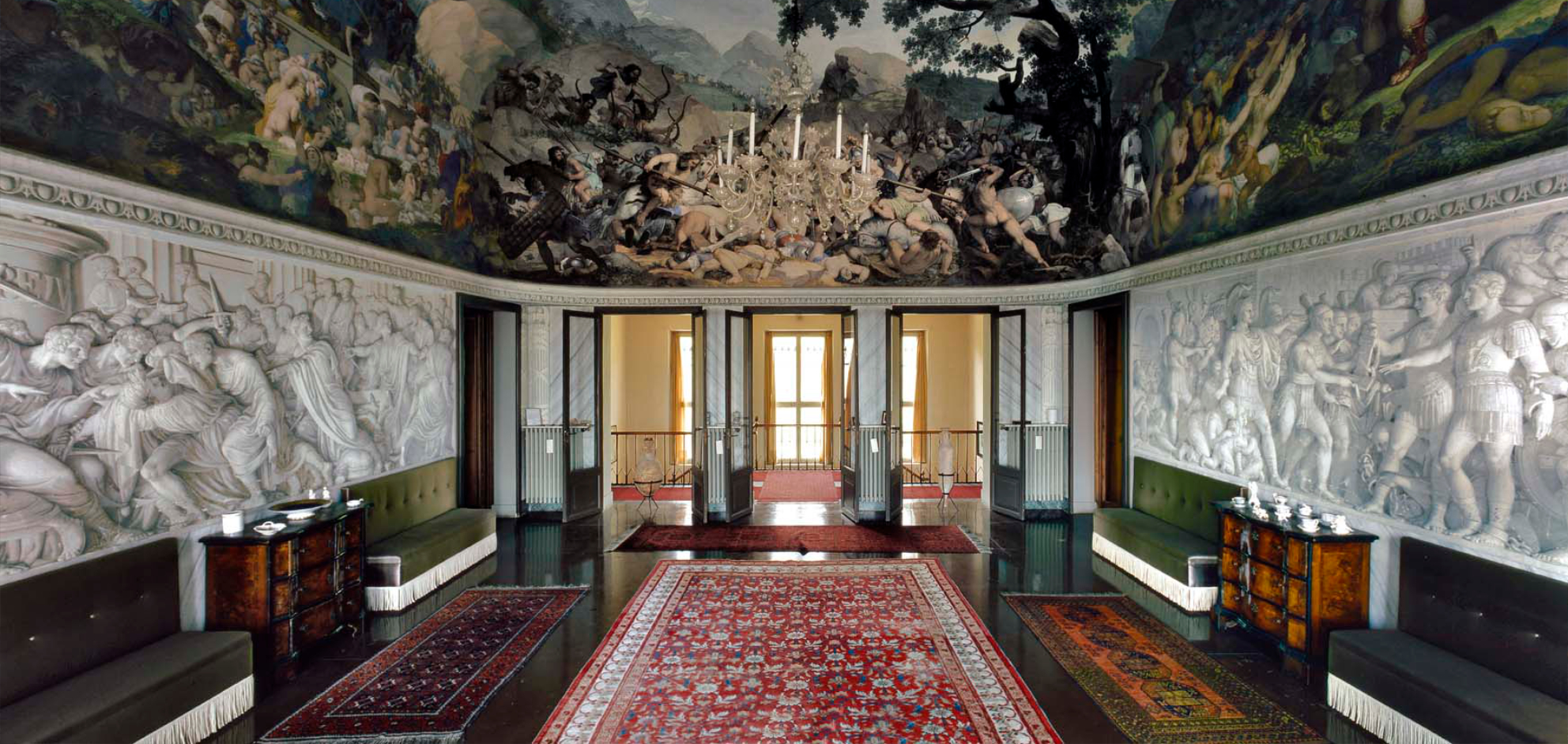
Villa Gera
In 1827, Bartolomeo Gera outlined his finest project, which still adorns the city today.
Consulting with Count Cicognara and his brother Vittore, an architect and agronomist, he identified Giuseppe Jappelli (Venice 1783-1852) as the perfect architect to realize his dream: a splendid villa that expresses only the beauty of art and that could be the pearl of Conegliano for all!
A building that soars upward, like the Parthenon, on a human scale, to the pace, life, and seasons of those who choose it as a retreat for study and conversation, a place of peace overlooking the plain.
Convinced of the need to promote art among young people, without social, political, class, or origin barriers, Bartolomeo chose Marco Casagrande, a young and undisputedly talented student of peasant origins, to sculpt the majestic tympanum displaying life-size figures to the city.
Architecture welcomes the Sister Arts and opens its home to them. A great example of Gera’s personality: opening its doors to anyone who can contribute through constructive dialogue to cultural, artistic, and social growth.
Being open to new ideas, being ready to embrace an unexpected but valuable project and make it your own, almost like boarding a moving train.
Thus the frescoes in the hall came to life: the cartoons with the drafts of the paintings that Giovanni Demin (1786-1859) presented to Bartolomeo in June 1835 were everything and the opposite of everything. Caesar and his army conquer the territory of the Helvetians: Glory. The native population, subjugated after a fierce battle, abandons their land with dignity to the foreigner: defeat. And Caesar, after his successes as a leader, perishes under the knife wounds of his family: redemption, the justice that history sometimes grants to the weakest.
It’s difficult not to read the irredentist influence of the anti-Austrian Risorgimento. Nonetheless, Bartolomeo accepts the risk and gives Demin the green light: to board the moving train and remain standing… Gera was 66 years old; a remarkable age at the time, but with a lively, youthful mind, focused on the future.
That future is our present; Bartolomeo died in 1848, but his message has never been more timely. It’s up to us to make it our own and rediscover his vision of life in today’s world, which was nothing other than his way of experiencing art and culture.
Villa Gera in Castello, after nearly two hundred years, still stands, on the hill of Giano, framed by the splendid landscape and the reassuring medieval walls along which an evocative walkway unfolds. And, today as then, its doors are open to those who, with love and respect, wish to experience culture as Bartolomeo Gera dreamed it, as the inscription on the small temple on the walls bears: Peace and Friendship.
Support us
Support the Conegliano Classica project.
Support our music association and help us
foster culture and a passion for music.